Let’s be honest: if you are a Product Manager or an Engineer in the medical device world, you have enough on your plate. You’re worrying about FDA approvals, clinical trials, and user interface designs. The last thing you want to lose sleep over is your medical device case.
But recently, we’ve noticed a shift in the conversations we’re having with our partners. The questions have changed. It used to be, “Can you make this shockproof?” (The answer is always yes). Now, it’s, “Can this survive a bleach wipe?” or “Is this material legal in California?”

What you will learn
- Why cleanability is now non-negotiable in healthcare settings
- How recyclability is reshaping case design
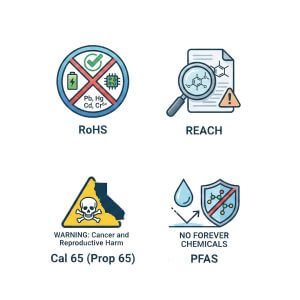
- A simple breakdown of RoHS, REACH, Prop 65, and PFAS
- Practical steps forward for your team
The world is changing. Medical device cases are no longer just about protection; they are about hygiene, sustainability, and navigating a complicated web of global regulations.
Cleanability, recyclability, and chemical compliance now shape medical device case materials and manufacturing choices. This guide explains the trends and practical ways to reduce risk.
If you’re feeling a bit overwhelmed by the “alphabet soup” of new requirements, you aren’t alone. Here is a human-readable guide to the trends shaping our industry right now—and how Shell-Case is tackling them.
Trend 1: Why Cleanability Matters in Medical Device Carrying cases

We all know that post-COVID, the standard for hygiene in hospitals and clinics has changed and even more for first responders. First Responders are busy; they don’t have time to gently disinfect a case. They are grabbing the nearest industrial-grade disinfectant wipe and scrubbing everything down.
The Problem:
Traditional “cut-and-sew” bags are basically sponges for bacteria. They have zippers, seams, and porous fabrics that trap germs and degrade quickly under harsh chemicals.
Industry Solutions:
Moving away from traditional fabric traps and offering advanced solutions such as laminated EVA Thermoformed shells or Advanced Bonding instead of stitching and so on. The idea is to create a case with smooth, non-porous surfaces. Think of it as a sleek, protective skin rather than a fabric bag.
Another effective solution is the use of Vacuum-Formed, Blow Molded or Injected Plastic case. These technologies eliminate most of the barriers to useful disinfection.
At Shell-Case you can wipe our cases down in seconds, ensuring they meet the strict infection control protocols without falling apart.

Trend 2: The “Green” Mandate

Sustainability isn’t just a buzzword anymore; it’s a requirement. We are hearing loud and clear from our customers that companies, hospitals, clinics (and the planet) are tired of unnecessary waste. The old way of making cases—gluing different non-recyclable materials together—is on its way out.
The Problem: How to build a strong, durable case for a medical device that is also recyclable?
Industry Solutions:
Rethinking the lifecycle of cases. At Shell-Case we are pushing heavily into using a “mono-material” design, cases made of a single family of plastics—so that when the device reaches the end of its life, it can be easily recycled.
Another trend is moving to blow Molded or injected plastic using recyclable thermoplastics.
The “Alphabet Soup” of Regulations (And Why You Should Care)
RoHS, REACH, and PFAS compliance are global rules limiting harmful chemicals in products. This is the part that usually gives engineers a headache. Regulatory bodies in Europe and the US are cracking down on chemicals. Here is the plain-English breakdown of what you need to look out for:
RoHS: Ensuring No Hazardous Substances in Cases For Medical Devices
RoHS stands for Restriction of Hazardous Substances. It is a European Union directive (originating as Directive 2002/95/EC) that restricts the use of specific hazardous materials found in electrical and electronic products (EEE).
In plain English: This is the EU saying, “No heavy metals like lead or mercury.”
The Risk: Even if your device is clean, if the zipper pull on your case has the wrong metal alloy, your whole shipment could get stuck at customs.
The Fix: We vet every supplier. Every foam, zipper, and logo plate we use is checked to ensure it’s free of restricted substances.
REACH: Meeting European Standards for Safe Chemicals
REACH stands for Registration, Evaluation, Authorisation and Restriction of Chemicals.
It is a comprehensive European Union regulation (Regulation (EC) No 1907/2006) that places responsibility on the industry to manage the risks from chemicals and to provide safety information on the substances.
In plain English: A massive European list of “Substances of Very High Concern” (SVHCs). This covers everything from dyes to plasticizers.
The Risk: REACH covers hundreds of chemicals. It’s easy to accidentally use a plasticizer that makes a handle feel soft but is actually on the blacklist.
The Fix: We stay glued to the updates so you don’t have to. We ensure our supply chain is transparent and REACH-compliant, so your passport to the European market remains valid.
Cal 65 (California Proposition 65)
Cal 65 (commonly referred to as Prop 65) stands for the California Proposition 65 (officially the Safe Drinking Water and Toxic Enforcement Act of 1986).
It is a California state law that requires businesses to provide warnings to Californians about significant exposures to chemicals that cause cancer, birth defects, or other reproductive harm.
In plain English: The reason you see “This product may cause cancer” warnings on everything in California.
The Risk: California is a huge market. Using the wrong vinyl without a warning label can lead to lawsuits and fines. But putting a cancer warning on a life-saving medical device? That’s a branding nightmare.
The Fix: We formulate our materials to be Prop 65 compliant whenever possible, so you can avoid the scary stickers and keep your brand trusting and clean.
PFAS: Navigating the Ban on ‘Forever Chemicals’ in Medical Devices
PFAS stands for Per- and Polyfluoroalkyl Substances.
Unlike RoHS, REACH, or Cal 65 (which are regulations), PFAS is a family of thousands of synthetic chemicals. They are often nicknamed “Forever Chemicals” because they do not break down naturally in the environment or the human body.
In plain English: These are chemicals used for decades to make things water-resistant. The problem? They never break down, and governments are banning them fast because they persist and bioaccumulate (build up) in the body.
The Risk: If your current case uses a standard water-repellent coating (DWR), it likely contains PFAS.
The Fix: While medical applications often qualify for exemptions due to performance needs, we’re moving to alternatives where possible. We are proactively switching to PFAS-free coatings. We also design cases that rely on mechanical waterproofing (like tight seals and rigid shells) rather than chemical coatings, keeping the environment safe and your product legal.
Need help auditing your current case? Explore our portfolio.
Key Takeaways
- Hygiene is Driving Design: Cases for medical device are shifting away from porous “cut-and-sew” fabrics to smooth, non-porous materials (like laminated EVA) that can withstand rigorous scrubbing with harsh, industrial-grade disinfectants.
- Sustainability is Mandatory: To meet the new “Green” mandate, manufacturers are adopting “mono-material” designs—cases made from a single family of plastics—to ensure the product is fully recyclable at the end of its life.
- Compliance is Critical for Market Access: Successfully selling globally now requires navigating a complex web of chemical regulations (RoHS, REACH, Prop 65, and PFAS), forcing companies to rigorously vet supply chains to avoid banned substances and warning labels.
Shell-Case Expertise in Action
“In conversations with customers, the focus has shifted from pure protection to cleanability, recyclability, and full regulatory compliance. We see this as an opportunity to innovate and support our partners fully.”
— Yuval Spector, Founder & CEO, Shell-Case
Here is the bottom line: You are experts in saving lives and improving health. You shouldn’t have to be experts in chemical regulations or textile engineering.
“Define your needs, no matter how complex. We’ll handle the solution. That’s our job!”
At Shell-Case, we don’t just “make boxes.” We serve as your partner in the compliance journey. We build compliance, cleanability, and sustainability into the case’s DNA to perfectly meet your needs.
FAQS
Why is cleanability important for medical device cases?
Hospitals and first responders require cases that withstand harsh disinfectants. Unlike porous fabric bags that trap germs, modern cases use smooth, non-porous materials like EVA shells or molded plastics for quick, effective disinfection.
How do "mono-material" designs improve sustainability?
Mono-material designs use a single family of plastics, avoiding the non-recyclable mix of glued materials found in traditional cases. This ensures the entire case can be easily recycled at the end of its life.
What key regulations impact medical device case manufacturing?
Manufacturers must navigate regulations like RoHS (hazardous substances), REACH (chemical safety), Prop 65 (California toxins), and PFAS bans. Compliance ensures market access by using safe materials and rigorous supply chain vetting.


